|
| Around 10% of the world's total fish species can be found just within the Great Barrier Reef. |
|
|
|
| When Anglerfish mate, they melt into each other and share their bodies forever. |
|
|
|
| Not all fishes lay eggs. |
| Fishes like split fins, surf-perches, and some sharks instead carry and give birth to live young. Scientists have also discovered that the embryos of some of these fishes actually consume each other in the womb. How’s that for creepy fish facts? |
|
|
| The Sea Anemone looks like a flower, but it’s actually a carnivorous animal that eats small fish and shrimp. |
|
|
|
| Fishes hear with both their ears and their skeletons, sensing the vibrations of sound in the water. |
| Scientists even suspect that sharks can clearly hear sounds from over 3 km away. |
|
|
| In three decades, the world's oceans will contain more discarded plastic than fish when measured by weight, researchers say. |
| |
|
|
| As of 2020, there were 34,000 known fish species around world. That’s more than the number of species in all other vertebrates: birds, reptiles, mammals, and amphibians combined. |
|
|
|
| Just how man species of fish are there? |
| As of 2020, there were 34,000 known fish species around world. That’s more than the number of species in all other vertebrates: birds, reptiles, mammals, and amphibians combined. |
|
|
| Even Catfish are finicky |
| Taste Buds ? Catfish have a more refined sense of flavor than humans. Our 10,000 taste buds may seem like a lot, but catfish can have as many as 175,000. This helps them find the exact location of their next meal. |
|
|
| Fish have built in radar? |
| Built-in Radar Many species of fish have a powerful sense organ called the lateral line running across their body. It can detect motion in the water, allowing them to hunt prey, avoid predators, and navigate in the dark. |
|
|
|
|
|
|
Welcome To the Tips & Tricks
|
|
You may Browse or Search in our database for a Tips & Tricks
|
|
or
|
|
You may Add your own Tip & Trick. Just click on the "Add Your Tip&Trick" button on the left and fill in the form.
|
|
THANK YOU!
|
 |
|
Feb 23, 2018; 07:00AM
|
|
Category: Guide Services
|
|
Name for Contacts: Quepos Fishing Charters
|
|
Phone: 1-800-388-9957
|
|
City: Quepos
|
|
State:
|
|
Country: Costa Rica
|
| Description: |
Quepos Fishing Charters is located
in the Quepos, Costa Rica and we
offer Full Day and 3/4 Day trips.
We’re ready to give you the fishing
experience of a lifetime!
|
|
|

|
|
|
Kids only 12 and under fishing photo contest
$50 worth of free fishing tackle for the photo with the most votes. Contest open to Kids only 12 and under at time of catch. Contest will be active once there are 8 contestants. Good luck to all.
|
Ian MoppertUnknown as f...Brown Trout |

Click the image for full story |
| Ian Moppert, 12 |
|---|
| Ian spotted this trout slurpping tiny midges on the far side of Dry... |
|
134 vote(s)
|
|
|
 |
|
Jul 30, 2001; 10:43PM - Trolling for albacore with rapala style lures.
|
|
Category: Fishing tips and tricks
|
|
Author Name: Matt
|
 Tip&Trick Description 1:
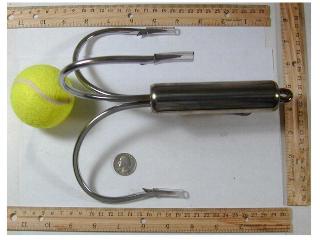
I just returned from a fishing trip on the Fin Fever out of Newport Beach, California and was I impressed with what they used to catch the tunas! We used Yozuri Hydromagnums in the to troll for the albacore tunas. I am telling you these were the hottest lures I have seen in a long time! They removed the front treble hook from the lures to make removal of the lure easier and faster from the fish. After multiple double and triple hookups I am convinced these are the hottest lures around! I asked to take a photo of the lures so I could get some and thanks to the crew and their hot tricks we caught our limit (all we wanted till we were tired of pulling on the fish!) Great trip with a great group of guys!! Hope this photo helps.......Matt
Tip&Trick Description 1:
I just returned from a fishing trip on the Fin Fever out of Newport Beach, California and was I impressed with what they used to catch the tunas! We used Yozuri Hydromagnums in the to troll for the albacore tunas. I am telling you these were the hottest lures I have seen in a long time! They removed the front treble hook from the lures to make removal of the lure easier and faster from the fish. After multiple double and triple hookups I am convinced these are the hottest lures around! I asked to take a photo of the lures so I could get some and thanks to the crew and their hot tricks we caught our limit (all we wanted till we were tired of pulling on the fish!) Great trip with a great group of guys!! Hope this photo helps.......Matt |
|
|
|
|
|
|
 |
|
Dec 9, 2007; 09:35PM - Custom Fit Boat Cover
|
|
Category: [other]
|
|
Price: Varies
|
|
Name for Contacts: Elite Outdoors
|
|
Phone:
|
|
City:
|
|
State: MO
|
|
Country: USA
|
 Description 1:
When only the best will do! A perfect fit: measured, tucked, darted and approved by Hurricane's own pattern and design craftsman. Vulnerable wear and stress points are double reinforced with an extra tough material sewn to the underside of the cover. An unbreakable 1/4' poly draw rope sewn with the perimeter hem enables the cover to be cinched tight to the hull. 1' poly loops are sewn around the perimeter of the cover to accept a Hurricane strap/buckle tie down kit, bungee cords, or rope ties for positive securing to the boat. Built tough to take the exposure and abuse that boat covers are exposed to when trailering, storing, or mooring.
Description 1:
When only the best will do! A perfect fit: measured, tucked, darted and approved by Hurricane's own pattern and design craftsman. Vulnerable wear and stress points are double reinforced with an extra tough material sewn to the underside of the cover. An unbreakable 1/4' poly draw rope sewn with the perimeter hem enables the cover to be cinched tight to the hull. 1' poly loops are sewn around the perimeter of the cover to accept a Hurricane strap/buckle tie down kit, bungee cords, or rope ties for positive securing to the boat. Built tough to take the exposure and abuse that boat covers are exposed to when trailering, storing, or mooring.
Westland has over 16,000 Exact Fit Custom Cover patterns for over 200 different boat manufacturers. You will have your choice of 3 fabrics and over 30 colors.
To check to see if we have a custom cover pattern for your boat please Email Us your year - make - model - any accessories like towers, swim platforms, bow rails, radar archs, etc. |
|
 Description 2:
Sharkskin color chart...also, available in Sunbrella
Description 2:
Sharkskin color chart...also, available in Sunbrella |
|
|
|
|
 |
|
Dec 30, 2013; 12:04AM - GORDO BANKS PANGAS San Jose del Cabo December 29, 2013
|
|
Category: Mexico Cabo San Lucas
|
|
Author Name: Eric Brictson
|

GORDO BANKS PANGAS
San Jose del Cabo
December 29, 2013
Anglers –
We are all now enjoying Christmas Holiday times, with the last week of
2013 now upon us, families and friends all gathering to reminiscent of
past times and to experience new adventures. What greater place than
Los Cabos to bring in the New Year, where the winter climate has been
very mild and vacationers are soaking up warm sunshine, participating
in many outdoor activities.
We have seen ocean water temperatures now drop down into the 71/73
degree range, this is normal for the time of year, clarity has become
more greenish in areas, but still the water is not what you would call
dirty. Anglers were finding fair numbers of late season dorado spread
out throughout the region, often times found very close to shore,
where concentrations of ballyhoo and other baitfish have been
attracting them. More often they are found in smaller sized schools,
striking on lures, rigging ballyhoo and live caballito. Sizes averaged
10 to 15 lb., with some larger dorado to 20 pounds also accounted for.
Finding yellowfin tuna was much harder, with cooler currents and lack
of sardina baitfish, no tuna action was being reported. There have
been more school of Bonita moving in over the structure, these are the
good eating variety, also have sharp teeth, almost like sierra,
scrappy fighters on light tackle, readily striking on trolled rapalas
and retrieved jigs, weighed up to 10 lb. Cooling water temperatures
have brought in more sierra along the shoreline, these aggressive fish
are hitting on small rapalas and hoochies, the action is best early in
the morning, if new sources of sardinas are located that will really
help the overall inshore fishing action. There has been shortages of
caballito as well as no sardinas at all to speak of, many charters are
relying on lures and rigged ballyhoo. We are anticipating reports of
schooling mackerel moving in on the local fishing grounds, but this
has not happened yet, it seems to be the season of changing baitfish
migrations, will be interesting to see what happens during this cold
water transition period, every season can be different.
Only a handful of wahoo are being reported, these elusive gamefish
fish never really did go on a consistent bite this season, with ocean
temperatures now in the low 70s, this is typically when wahoo start to
migrate in a southern direction to follow preferred temperate
currents. Though we do expect we will see a few more wahoo in the fish
counts before they vanish for the winter, often these fish will bite
later in the day during this period of colder water, sunshine seems to
warm surface temperature up and gets them more active.
Anglers have found minimal success searching for bottom species,
finding more triggerfish, skipjack and bonita than anything else. The
month of December was windy more often than not, northern winds were
persistent, with only a few days of calmer conditions mixed in, this
stirs ocean conditions, scatters bait schools and makes it hard to
find productive bottom action.
Billfish are scattered on the offshore grounds, no concentrations,
striking lures and ballyhoo and caballito. Some striped marlin were
being hooked while drift fishing baits deeper over the areas where
they were seen occasionally free jumping of tailing on the surface. We
all know this is the season where a huge striped marlin frenzy could
develop on any given day, if any bait concentration is encountered be
prepared for action.
The combined panga fleets launching out of La Playita, Puerto Los
Cabos Marina sent out approximately 88 charters for this past week,
with anglers accounting for a fish count of:
6 striped marlin, 3 wahoo, 85 bonito, 134 sierra, 15 roosterfish, 165
dorado, 5 hammerhead shark and 22 pargo.
Good fishing, Eric
--
GORDO BANKS PANGAS
Eric Brictson / Operator
619 488-1859
Los Cabos (624) 142-1147
e-mail:gordobanks@yahoo.com
WWW.GORDOBANKS.COM
|
|
|
|
|